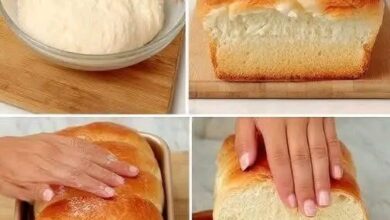
I’ve gathered information from several recipes for 4-ingredient bread to give you a comprehensive overview. Below, you’ll find a detailed breakdown that covers the basics, key recipe variations, and the benefits of baking your own bread.
🥖 Key Recipe Overviews
Here is a side-by-side look at three popular types of 4-ingredient bread. The Classic Artisan Loaf is a great place to start for a classic, crusty bread. The Quick French Bread is ideal if you want results in under an hour. The No-Knead Rustic Loaf is perfect for a hands-off approach with simple shaping.
· Classic Artisan Loaf
· Primary Flour: Bread flour or all-purpose
· Key Feature: Long, cold fermentation for flavor
· Typical Bake Vessel: Baking sheet or Dutch oven
· Total Time (Approx.): 4.5 hours to 3 days
· Quick French Bread
· Primary Flour: Bread flour
· Key Feature: Ready in about 1 hour total
· Typical Bake Vessel: Baking sheet
· Total Time (Approx.): 1 hour
· No-Knead Rustic Loaf
· Primary Flour: Unbleached all-purpose or bread flour
· Key Feature: Single rise, very simple shaping
· Typical Bake Vessel: Dutch oven, skillet, or baking sheet
· Total Time (Approx.): 3-4 hours
📋 The Core Ingredients
Despite variations, all these recipes are built on the same four foundational ingredients:
· Flour: Bread flour is highly recommended for its higher protein content, which creates a stronger, chewier crumb with better structure. All-purpose flour works perfectly well and is more readily available. Whole wheat flour can be used but often only as a partial substitute (e.g., 20-40%) to avoid a dense loaf.
· Yeast: Instant (or rapid-rise) yeast is commonly used for convenience, as it can be mixed directly with dry ingredients. Active dry yeast also works but may require a slightly longer rise time.
· Water: Temperature is important. For most recipes using instant yeast, cool or room temperature water (around 70°F/21°C) is used to slow fermentation and develop flavor. For faster recipes or those using active dry yeast, warm water (110°F-130°F/43°C-54°C) is used to activate the yeast.
· Salt: Kosher salt or coarse sea salt is preferred for its clean flavor. If using fine table salt, use about half the amount to avoid over-salting. Salt is crucial for flavor and also regulates yeast activity.
🔧 Essential Methods & Pro Tips
Mastering a few simple techniques will ensure great results:
· Mixing & Rising: Combine ingredients until no dry flour remains; the dough will be shaggy and sticky. The first rise (bulk fermentation) is critical. For deeper flavor, let the dough rise slowly in the refrigerator for 12 hours to 3 days. For quicker bread, a 1-3 hour rise at room temperature works.
· Shaping & Baking: Handle the risen dough gently on a floured surface to preserve air bubbles. For a crisp crust, bake in a preheated Dutch oven with a lid for the first part of baking. This traps steam, mimicking a professional oven. Scoring the top of the loaf with a sharp knife just before baking controls expansion and creates a professional look.
· Common Pitfall: The most frequent mistake is adding too much flour during shaping because the dough is sticky. Resist this, as a wetter dough leads to a better, airier crumb. Use wet or oiled hands instead to handle sticky dough.
💡 Benefits and History
Baking bread at home offers several advantages. You have complete control over the ingredients, avoiding the preservatives and additives found in many store-bought loaves. It can be more economical, and the process itself is a rewarding, sensory experience that many find therapeutic and impressive to share. Scientifically, using whole grain or legume flours can increase the fiber and nutrient content of bread, though this may slightly alter the texture.
The use of just flour, water, salt, and a leavening agent is ancient. The specific “no-knead” method popularized in the 21st century highlights how simple techniques and time can replace strenuous labor to create excellent bread.
🍽️ Serving, Storage & Nutrition
· Serving: Fresh, warm bread is incredibly versatile. It’s perfect for slathering with butter or dips, serving alongside soups and stews, or making into croutons or garlic bread.
· Storage: Keep the loaf at room temperature in a paper bag or wrapped in a cloth for up to 2-3 days to preserve the crust. For longer storage, slice and freeze for up to 3 months. Reheat frozen slices in a toaster or oven.
· Nutrition: A basic slice (about 30g) made with white flour provides roughly 80-100 calories, primarily from carbohydrates, with small amounts of protein and fat. For a nutritional boost, you can substitute up to half the white flour with whole wheat flour to add fiber, vitamins, and minerals.
🧑🍳 For the Bread Lover
Once you master the basic dough, the possibilities for customization are endless. Try these easy additions:
· Savory: Rosemary and garlic, shredded cheese and jalapeño, sun-dried tomatoes and olives.
· Sweet: Cinnamon and raisins, dried cranberries and orange zest, chopped nuts.
For a new challenge after mastering the 4-ingredient loaf, consider exploring sourdough for its complex flavor, enriched doughs like brioche, or shaping techniques for baguettes, rolls, or focaccia.
I hope this detailed guide helps you bake wonderful bread. If you have a specific type of loaf in mind or want more details on a particular technique, just let me know