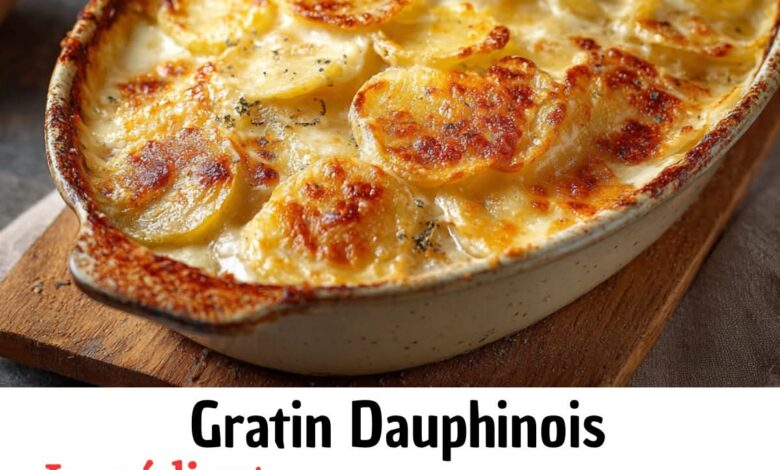
Here is the complete recipe for Paul Bocuse’s Gratin Dauphinois, with all the information you requested.
🍽️ Introduction
“Le Gratin Dauphinois” is considered a pinnacle of French comfort cuisine. Originating from the Dauphiné region of southeastern France, this dish transforms humble potatoes and cream into something sublime. The recipe from Paul Bocuse, the legendary “Chef of the Century,” is a masterclass in simplicity and technique, where patience and quality ingredients yield a meltingly tender, golden, and unforgettable result.
📜 A Dish with History
The first recorded mention of Gratin Dauphinois dates to July 12, 1788, where it was served to municipal officials in the town of Gap, France. The name “Dauphinois” refers to its region of origin, Dauphiné. A key distinction for purists is that the traditional, authentic Gratin Dauphinois does not contain cheese—it relies solely on cream, garlic, and potatoes to create its magic. Adding cheese technically turns it into a Gratin Savoyard. However, many modern chefs, including Bocuse, have embraced adding cheese for extra richness and flavor.
🛒 Ingredients
Here is what you’ll need to make Bocuse’s version for 6-8 people. The core ingredients are simple, but their quality is paramount:
Core Components:
· Potatoes: 1 kg (2.2 lbs) of starchy potatoes (e.g., Russet in the US, Sebago in Australia, or Charlotte/Monalisa in Europe). Starch is essential for a creamy sauce.
· Dairy: 700 ml (about 3 cups) of whole milk and 300 ml (about 1 ⅓ cups) of heavy cream. This is the soul of the dish.
· Aromatics & Seasoning: 2 cloves of garlic, freshly grated nutmeg, salt, and pepper.
Preparation Tools:
· A mandoline or sharp knife for slicing
· A large, buttered baking dish (approx. 28x16x7 cm for 8 servings)
· Aluminum foil
👨🍳 Paul Bocuse’s Method & Instructions
Paul Bocuse’s method involves a gentle pre-cook on the stovetop followed by slow baking, ensuring the potatoes become incredibly tender without the cream breaking.
Step 1: Prepare the Potatoes
Peel the potatoes. Using a mandoline or sharp knife, slice them uniformly to a thickness of about 2 mm (1/16 inch). Do not rinse the slices—the surface starch is crucial for thickening the cream sauce.
Step 2: Create the Cream Infusion
In a large pot or Dutch oven, combine the milk, heavy cream, crushed garlic cloves, a generous pinch of salt, pepper, and nutmeg. Add all the sliced potatoes.
Step 3: Pre-Cook on the Stovetop
Bring the mixture to a gentle simmer over medium-low heat. Cook for about 10-15 minutes, just until the potatoes begin to soften but are not fully cooked. Stir gently to prevent sticking. This step infuses the potatoes with flavor and starts the sauce.
Step 4: Assemble and Bake
1. Preheat your oven to 150°C (300°F). This low temperature is key to Bocuse’s method.
2. Generously butter your baking dish to prevent sticking and add flavor.
3. Carefully transfer the potato and cream mixture into the prepared dish, arranging the slices evenly.
4. Cover the dish tightly with aluminum foil and bake on the middle rack for 50 minutes.
5. Remove the foil. If you are using cheese (like Gruyère), sprinkle it over the top now. Increase the oven temperature to 180°C (350°F) and bake for an additional 20-30 minutes, until the top is a deep, golden brown and the potatoes are completely tender when pierced with a knife.
Step 5: The Critical Rest
One of Bocuse’s secrets is resting. For the best texture and melded flavors, let the gratin cool to room temperature after baking, then refrigerate it overnight. The next day, reheat it gently in a low oven before serving. At a minimum, let it rest for 15-20 minutes after baking; this allows the creamy sauce to set perfectly.
✨ Chef’s Tips for Success
· Potato Choice is Key: Use high-starch potatoes. Avoid waxy varieties, as they won’t break down properly and can cause the layers to separate.
· Prevent Curdling: The combination of high-fat cream and slow, low-temperature baking prevents the sauce from separating. Avoid boiling the cream mixture vigorously.
· Make-Ahead Friendly: This dish is ideal for preparing ahead. You can assemble and bake it a day or two in advance and reheat it before serving.
📊 Nutrition & Dietary Notes
Gratin Dauphinois is a rich, indulgent dish. A typical 100g serving may contain approximately:
· Calories: ~180
· Fat: 12g
· Carbohydrates: 13g
· Protein: 3g
Considerations:
· Vegetarian: The core recipe is vegetarian (ensure any cheese used is rennet-free for strict vegetarians).
· Gluten-Free: Naturally gluten-free.
· High in Saturated Fat: Due to the cream and butter. For a lighter version, some recipes use a mix of milk and cream, though the texture will be less luxurious.
🤝 For the Lovers of Food
This gratin is the ultimate crowd-pleaser and a versatile companion. It pairs wonderfully with:
· Roasted or grilled meats: Such as a standing rib roast, roast lamb, or steak.
· Poultry: Perfect with roast chicken, turkey, or duck.
· Hearty stews: Try it alongside a classic Beef Bourguignon.
For wine, a white wine from the gratin’s native region, like a white Rhône (e.g., Crozes-Hermitage), makes a fantastic pairing.
🎉 Conclusion
Paul Bocuse’s Gratin Dauphinois is more than a recipe; it is a celebration of fundamental French cooking principles: respect for quality ingredients, mastery of technique, and the patience to let flavors develop. Whether you adhere to the cheese-less tradition or embrace Bocuse’s cheesy addition, this gratin promises a deeply satisfying, creamy, and golden result that is sure to earn a place at your table for generations.
I hope you enjoy making and sharing this classic dish! If you’d like, I can also find you a more traditional, no-cheese recipe for comparison.