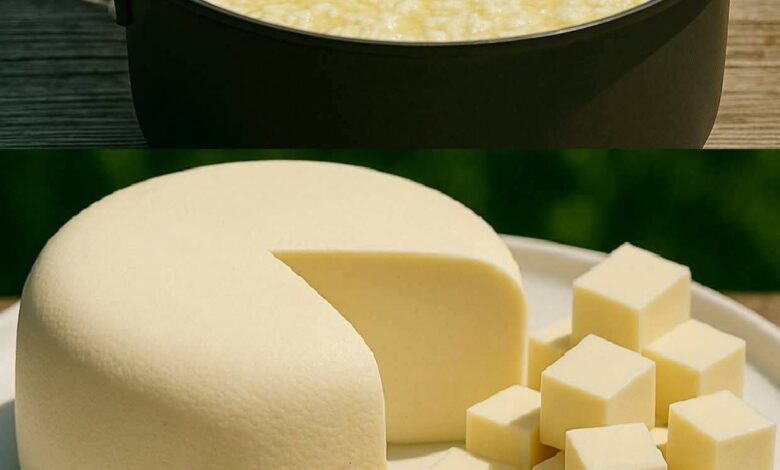
Here is a comprehensive guide to making Fresh Homemade Paneer (Indian Cheese) using vinegar. This recipe is a staple in Indian households and a perfect introduction to home cheese-making because it requires no special cultures, rennet, or aging.
Here is the complete breakdown you requested.
1. Introduction: The Magic of Milk Transformation
There is something almost alchemical about turning a simple gallon of milk into a beautiful, solid block of fresh cheese. This recipe for Paneer (or Farmer’s Cheese) using vinegar is the simplest and most rewarding way to begin your cheese-making journey. Unlike aged cheeses that require months of waiting, this cheese is ready in under an hour. The acidic nature of vinegar causes the milk to separate into soft, white curds and translucent whey. The result is a mild, slightly tangy, and incredibly versatile cheese that is far superior in texture and taste to most store-bought versions. It is firm enough to grill or fry without melting, making it a protein-packed star in curries, salads, and stir-fries.
2. The Lovers (Why People Adore This Cheese)
· The Home Cook: Loves its simplicity. With just two main ingredients, anyone can create a fresh, chemical-free product in their own kitchen.
· The Vegetarian: Paneer is a critical source of protein in lacto-vegetarian diets, especially in South Asian cuisine. It provides a hearty, satisfying texture that mimics meat in dishes.
· The Health Enthusiast: Appreciates that they can control the quality of the milk (using organic, grass-fed, or low-fat options) and avoid the preservatives, emulsifiers, and excess sodium often found in packaged cheeses.
· The Experimenter: Loves that this is a blank canvas. Once the basic technique is mastered, it can be flavored with herbs, spices, or black pepper for a personalized touch.
3. History & Origin
The exact origins of paneer are disputed, but it is one of the oldest non-melting cheeses in South Asia.
· Ancient Roots: Some legends trace it back to Persian and Afghan rulers who traveled to the Indian subcontinent, carrying the concept of preserving milk with acid. However, other evidence points to indigenous development in parts of India and Bangladesh.
· Vedic Period: References to a milk product called dadhanwat (which could refer to a type of cheese or fermented milk product) appear in ancient Vedic texts, suggesting that the principles of coagulating milk have been known for thousands of years.
· Modern Staple: Regardless of its precise origin, paneer became a cornerstone of Mughlai and Punjabi cuisine. In a time before widespread refrigeration, the technique of curdling milk with an acidic agent (like leftover whey, lemon juice, or vinegar) was a crucial method of preserving milk nutrients in a hot climate. It remains an integral part of Indian cuisine today.
4. Formation (The Science Behind the Curds)
Cheese-making is essentially a process of dehydration and concentration. Here’s the simple science of what happens when you add vinegar to milk:
· The Structure of Milk: Milk is an emulsion of water, fat, and proteins. The primary protein is casein. In fresh milk, casein molecules are suspended individually, each repelling the other. They are kept stable by a protein “hair” on their surface called kappa-casein.
· The Role of Acid (Vinegar): Milk is naturally slightly acidic. When you add an acid like vinegar (acetic acid), you lower the pH of the milk even further. This neutralizes the negative charge on the kappa-casein “hairs.”
· Coagulation: Once the charge is neutralized, the casein molecules no longer repel each other. Instead, they begin to attract and clump together. These clumps trap the milk fat, forming a gel-like network. This process is called coagulation. The solid parts are the curds, and the remaining greenish liquid is the whey, which contains water, lactose, and minerals.
5. Key Information
· Prep Time: 5 minutes
· Cook Time: 10 minutes
· Resting/Pressing Time: 20-30 minutes
· Total Time: ~45 minutes
· Yield: Approximately 200-250 grams (from 2 liters/ half gallon of milk)
· Cuisine: Indian, Global
6. Ingredients
· Milk: 2 liters (or ½ gallon) of Full-Fat Milk. Do not use ultra-pasteurized (UHT) milk, as it will not form good curds. Whole milk is best for a creamy texture, but you can use low-fat milk for a leaner, firmer (though slightly less rich) paneer.
· Acid: 3-4 tablespoons of White Distilled Vinegar or Apple Cider Vinegar. Lemon juice is a great alternative.
· Optional Flavorings: 1 teaspoon of salt (add to milk), fresh or dried herbs (like cilantro or mint, kneaded into the curds), or crushed black pepper/cumin seeds.
· Ice Water Bath: A large bowl filled with ice and water (for shocking the cheese).
7. Equipment
· Heavy-bottomed pot (at least 5-liter capacity)
· Slotted spoon or wooden spatula
· Measuring spoons
· Large fine-mesh strainer or colander
· A large piece of Butter Muslin or a very clean, thin kitchen towel (cheesecloth is often too thin; multiple layers are needed)
· Kitchen twine or a clip (optional, for hanging)
· A heavy object (like a pan filled with water or a couple of cans) for pressing
· A plate and a tray or bowl to catch the whey runoff
8. Instructions (Step-by-Step Method)
Step 1: Prepare Your Station
Line your colander with the muslin cloth and place it in the sink or over a large bowl to catch the whey. Prepare your ice water bath in a separate large bowl.
Step 2: Heat the Milk
Pour the milk into the heavy-bottomed pot. Heat it over medium flame. Stir occasionally to prevent the milk from scorching at the bottom. Bring the milk to a full, rolling boil. You’ll see it rise and froth.
Step 3: Add the Vinegar
Once the milk is boiling, turn off the heat. Add 3 tablespoons of vinegar, stirring gently but continuously. You should see the milk separate almost immediately into white curds and a clear, greenish-yellow whey. If the whey is still milky, add the remaining 1 tablespoon of vinegar and stir again.
Step 4: Rest and Drain
Let the mixture sit undisturbed for 5-10 minutes to allow the curds to firm up and settle. Gently pour the contents of the pot into the cloth-lined colander. The whey will drain away.
Step 5: The Crucial Rinse (For Texture)
This is the secret to soft, non-rubbery paneer! Gather the edges of the cloth and lift the bundle. Dip the entire bundle (curds and all) into the ice water bath for 30-60 seconds. This stops the cooking process and keeps the paneer tender. Remove, let the excess ice water drain, and then rinse the bundle briefly under cool running water to remove any vinegar taste.
Step 6: Pressing (For Firmness)
Place the cloth-wrapped curds on a plate or your work surface. Flatten it into a uniform disc about 1-inch thick. Place another plate on top and weigh it down with the heavy object (like a pan of water). Let it press for 20-30 minutes. The longer you press, the firmer the cheese will be. For a soft, crumbly cheese, press for only 10-15 minutes.
Step 7: Remove and Use
Unwrap the cheese. It should be a solid, cohesive block. Cut it into cubes or slices as desired.
9. Nutrition (Approximate per 100g serving, using whole milk)
· Calories: ~265 kcal
· Protein: ~18g
· Fat: ~21g
· Carbohydrates: ~2g
· Calcium: ~200mg (Excellent for bone health)
· Note: This is a rough estimate and will vary based on the fat content of your milk.
10. Benefits
· High-Quality Protein: Contains all nine essential amino acids, crucial for muscle repair and growth.
· Rich in Calcium: Essential for strong bones and teeth, and for proper nerve and muscle function.
· Conjugated Linoleic Acid (CLA): Found in dairy fats, CLA has been linked to various health benefits, including improved immune function and anti-inflammatory properties.
· No Preservatives: Homemade paneer contains exactly what you put into it—no artificial colors, flavors, or excessive salt.
· Lactose-Friendly: Much of the lactose (milk sugar) drains away into the whey during the cheese-making process, making fresh cheese easier to digest for some lactose-sensitive individuals.
11. Conclusion
Making cheese at home with vinegar is a testament to the fact that the most delicious things in life are often the simplest. It connects you to an ancient culinary tradition and rewards you with a product that is far fresher and more flavorful than anything you can buy. The process is forgiving, quick, and incredibly satisfying. From the moment you watch the milk transform into curds and whey to the final slice of the firm, white block, you’ll feel a sense of accomplishment. Whether you use it in a rich Palak Paneer, grilled on a skewer, or simply fried with a sprinkle of salt and pepper, this homemade cheese is sure to become a beloved staple in your kitchen.
Bonus: What to do with the Leftover Whey?
Don’t throw away the leftover whey! It’s packed with protein and nutrients. Here are a few methods to use it:
· In Cooking: Use it as a substitute for water when cooking rice, lentils (dal), or pasta for an extra boost of nutrition and a subtle tangy flavor.
· In Baking: Replace water or milk in bread, pizza dough, or pancake batter with whey.
· For Smoothies: Add a splash to your morning smoothie for a protein kick and a thinner consistency.
· As a Soup Base: Use it as the stock for vegetable soups.
· Feed Your Plants: Once cooled and diluted with water (50/50), whey can be used to water acid-loving plants like tomatoes, roses, and blueberries.